Mar 16, 2026
Employee Handbook vs. Policies Manual: What’s the Difference (and Which Do You Need)?
employee-handbook-vs-policies-manual-what-to-choose-2026
Introduction
If you’ve searched “employee handbook template” and “company policies manual,” you’ve probably noticed people use the terms interchangeably. They’re related—but not the same. For small businesses, choosing the right one matters because it affects clarity, compliance, and how quickly you can get something usable in place.
This post breaks down the difference, when you need each, and what to include so you can stop overthinking it and move forward.
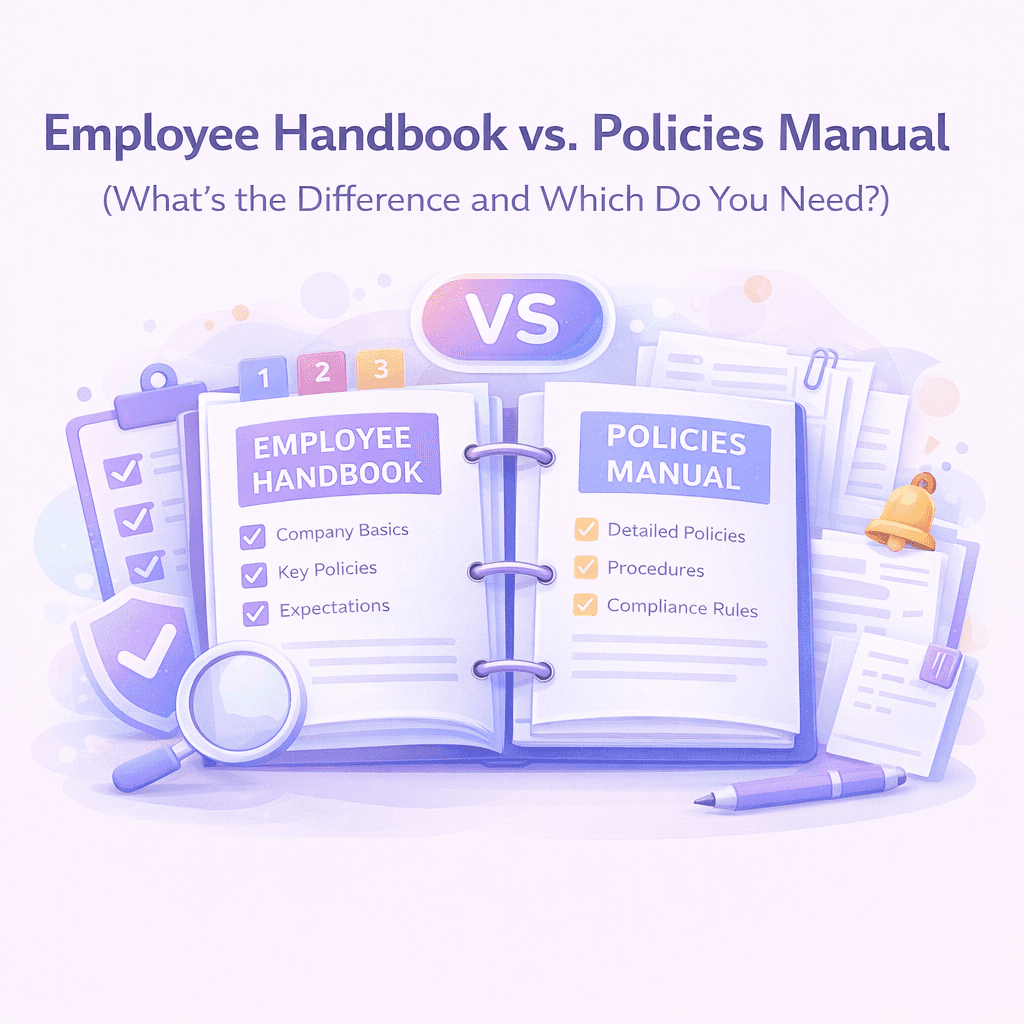
Employee Handbook vs. Policies Manual (Simple Definitions)
Employee Handbook (the “why + how we operate” document)
An employee handbook is the “single source of truth” for how your company works. It typically includes:
Your company values and expectations
How employment works (classification, schedules, time off)
Behavioral standards (conduct, attendance, performance)
High-level policy summaries (with references to full policies where needed)
The acknowledgment page employees sign
Best for: companies that want consistency, culture, and fewer repeat questions.
Policies Manual (the “full policy details” document)
A policies manual is more like a reference binder. It can be longer and more detailed, often including:
Step-by-step rules and procedures
Detailed compliance language
Role-specific rules
Expanded safety/security policies
Appendices, forms, and internal admin processes
Best for: companies that want deeper detail, regulated environments, or more complex operations.
Which Do Small Businesses Need?
For most small businesses, the best answer is:
Start with an employee handbook.
Because it gives you:
A clear baseline for expectations
A framework for consistent decisions
A place to document core policies without writing a 60-page manual
Add deeper policy docs later (only if needed).
If you grow into complexity (multiple locations, multiple states, regulated processes), you can build a policies manual over time.
Rule of thumb:
Handbook = what employees need to know to work well here
Policies manual = the deeper details you reference when needed
What to Include in a Small Business Employee Handbook (Minimum Viable Version)
If you want a clean, professional handbook that’s “enough” to start, include these sections:
Welcome + Company basics
Employment classifications (at-will language where applicable, intro periods, etc.)
Hours, scheduling, attendance
Pay practices + timekeeping
Time off (PTO, sick time, holidays, leave basics)
Conduct + workplace standards (harassment, discrimination, professionalism)
Technology + acceptable use
Safety + security basics
Discipline + performance (high-level approach)
Acknowledgment page (signature)
When You Should Have Both
You’ll benefit from having both a handbook and a policies manual if:
You operate in multiple states
You have safety-sensitive work
You have multiple departments with unique procedures
You’ve had repeated issues that require clear step-by-step rules
You’re preparing for audits, funding, or enterprise customers
In that case: keep the handbook readable and employee-friendly, and link out to deeper policy docs (PDFs or internal pages) for the detailed procedures.
The Fastest “Done” Approach (without getting stuck)
If your goal is to be live and selling (and not building a giant HR library), do this:
Step 1: Publish a solid handbook first (simple, clear, complete enough).
Step 2: Add 3–5 deeper standalone policies only if needed (ex: PTO policy details, remote work policy, discipline policy, device policy).
Step 3: Expand over time based on real issues you see (not hypothetical ones).
Want a Simple Way to Generate Yours?
If you’d like, you can use DraftHandbook to generate a clean employee handbook template tailored to your state and company size (and update it as you grow).